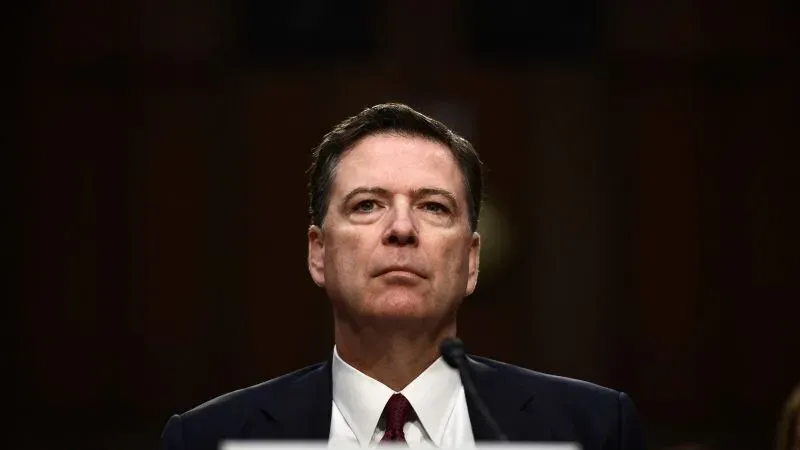
Justice Dept. Charges Ex-FBI Chief James Comey a Third Time
The US Department of Justice has taken another legal step against former FBI Director James Comey over allegations that he directed staff members to disclose classified information to a journalist more than a decade ago. The case marks the third occasion on which prosecutors have pursued criminal allegations against the former federal law enforcement chief.
According to court documents made public Monday, the allegations concern the alleged disclosure of a sensitive national security document in October 2016, when Comey was leading the FBI. His legal team maintains that the matter had already been investigated by authorities in the past, but those inquiries did not result in criminal charges.
Comey strongly criticized the latest development, arguing that it reflects an alarming misuse of the Justice Department's authority. In a video shared on social media, he said the situation might appear almost laughable if it were not so serious, warning that the public should not become accustomed to what he views as an abuse of prosecutorial power.
The Justice Department has offered a different explanation for its recent filing. Officials say the document outlining the allegations, known as a criminal information, does not itself constitute an enforceable charge in the case. Instead, the filing was intended to preserve the government's ability to pursue the matter by extending the deadline for bringing charges under the Espionage Act.
A department official explained that federal prosecutors commonly use criminal informations to pause the running of a statute of limitations and that several federal appellate courts have recognized the practice. The official added that the investigation remains active and declined to provide further details.
The legal dispute is now likely to hinge on whether the government's filing can legitimately preserve the case after the applicable deadline has passed. A judge will ultimately determine whether the Justice Department followed the law and whether its procedural approach is sufficient to allow prosecution to continue.
Earlier this month, Comey sought to have the case dismissed. His attorneys argued that prosecutors were required to obtain an indictment within the applicable 10-year period and that the document submitted by the government did not meet that legal requirement.
Although the case was made public on Monday, the available court records provide limited information about the precise conduct prosecutors believe amounted to a criminal offense. The lack of detailed allegations leaves significant questions about the government's evidence and the legal basis for moving forward.
President Donald Trump, when questioned about the case after returning to Washington from an event in Mississippi, said he had only recently heard about the development. Trump criticized Comey, describing him as a corrupt law enforcement official, but said he had no specific knowledge of the latest proceedings.
The dispute over the alleged disclosure of information to The New York Times dates back to the early period of Trump's first presidency. After Trump dismissed Comey from his position as FBI director in 2017, Comey shared at least one memorandum with members of his team that documented conversations he had held with the president. Information from the material was subsequently provided to a reporter at the newspaper.
Comey's handling of the memoranda and the circumstances surrounding the alleged disclosures have been examined in several government investigations. These included an inquiry by the Justice Department's inspector general and a separate investigation led by Special Counsel John Durham.
Durham was appointed to investigate the origins of the federal inquiry into Russian interference in the 2016 US presidential election. His investigation resulted in criminal charges against three individuals connected to the broader matter. Although his final findings criticized certain decisions made by Comey and other senior officials, the investigation did not produce evidence that led to criminal prosecutions of those officials over their conduct.
The latest case is not the only legal matter involving the former FBI director. Comey is also facing a separate criminal allegation in North Carolina related to a social media post published last spring. The post featured seashells arranged on a beach to display the characters “8647,” which prosecutors have interpreted as a threat directed at Trump.
Comey has disputed the accusations against him, while the broader legal proceedings have raised questions about the boundaries between political expression, alleged misconduct and criminal liability.
Another previous prosecution involving Comey, which concerned his congressional testimony about disclosures to the media, was dismissed by a judge last year. That outcome adds to the complicated legal history surrounding the former FBI director and the investigations into his conduct.
Elie Honig, a former federal prosecutor and senior legal analyst for CNN, questioned the legality of the Justice Department's latest procedural move. He argued that using a criminal information to get around an expired statute of limitations could be improper.
Honig explained that a criminal information generally requires the defendant's agreement in circumstances relevant to the case, and Comey had not provided that consent. In his assessment, the filing was therefore unlikely to be sufficient to extend the deadline, which he said expired on October 5, 2026.
The dispute over the filing is expected to become a central issue as the court considers whether the government can proceed. The outcome could determine whether prosecutors retain the authority to pursue the allegations or whether the case must be dismissed on procedural grounds.
For now, the precise scope of the allegations and the strength of the government's legal position remain unclear. The court's eventual ruling on the statute of limitations could prove decisive in determining the future of the case.